
Addressing operational inefficiencies while supporting clean energy solutions with advanced energy management technology.
Industry Challenges
Our Engineered Technology & Benefits
How CleanDesign Powers Community Services with Renewable Energy
$6M +
26,000 tons
10,000
Advanced Software and Controls
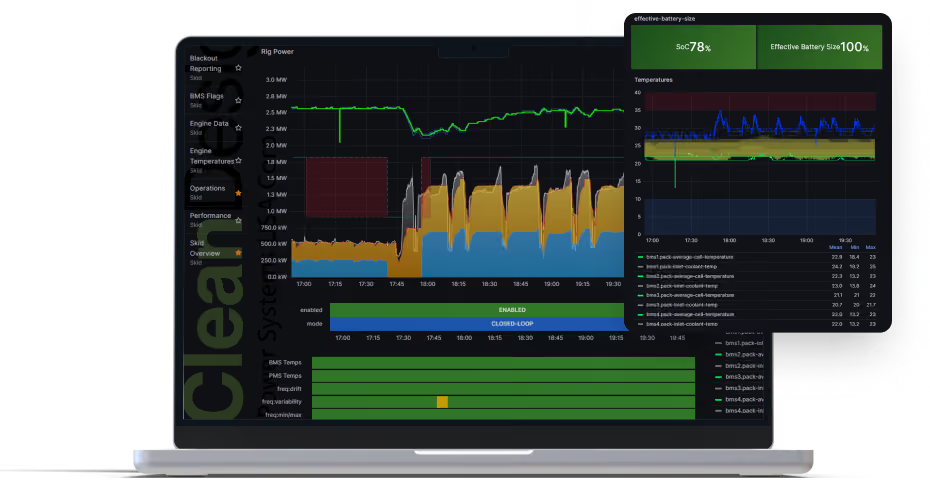
The system gathers data at a millisecond level, allowing predictive maintenance and reduced downtime, ensuring your operations are always at peak efficiency.
Our software continuously monitors and manages energy loads, automatically adjusting to optimize performance and reduce costs.
By leveraging machine learning, our system improves over time, learning from past performance to enhance future operations.
Our intelligent controls minimize the risk of blackouts by managing power distribution efficiently, keeping operations running smoothly.
Invest in the Future of Energy
Transforming energy management for a greener future.
Once the hEMS are fully deployed, they are cash-generating.

CleanDesign manufactures hEMS that can be contracted and installed in multiple verticals, bringing savings and reducing GHG emissions.

Trusted by Industry Leaders

“Precision Drilling plans to adopt battery energy storage as a standard piece of equipment on its drilling rigs […] [CleanDesign’s] ESG solution that “pays for itself” is a powerful offering to integrate with our drilling rig fleet […] Precision Drilling understands that many lead customers and other players in the oil and gas industry are committing to large scale rollouts with CleanDesign, and Precision Drilling will be looking to make similar commitments to a long-term relationship.”
“In collaboration with our customers, H&P looks for projects to apply alternative energy solutions. When feasible, alternative energy solutions can be mutually beneficial opportunities to reduce our emissions and those of our customers, working toward our short- and long-term environmental goals. In 2023, H&P worked with CleanDesign and a leading exploration and production company to expand the use of energy storage to utilize batteries to help power rigs for this customer. ”
Meet the Experts Behind CleanDesign




Ready to Transform Your Energy Management?
.avif)
Frequently Asked Questions
What is a hybrid energy system, and how does CleanDesign's hEMS work?
A hybrid energy system combines multiple power sources, such as diesel or natural gas generators, battery storage, and renewables, under one intelligent control platform. As one of the energy management systems companies supporting high-power industries, CleanDesign's Hybrid Energy Management System (hEMS) integrates battery storage, engine automation, and machine learning to optimize power in real time across oil and gas, mining, remote communities, and EV charging applications.
What is energy storage, and why does it matter for industrial power management?
Energy storage refers to capturing power (often from generators or renewable sources) in batteries so it can be deployed later when demand is highest. In CleanDesign's hEMS, energy storage systems reduce the need for generators to run constantly, cutting fuel use, lowering emissions, and reducing wear on equipment.
How do battery energy storage systems reduce fuel consumption and emissions?
Battery energy storage systems allow generators to run only at their most efficient load points instead of constantly throttling to meet demand. Based on CleanDesign's 2024 deployment data across 22 units, this can reduce diesel fuel consumption by up to 48% and lower GHG emissions by approximately 26–29% per rig.
What industries does CleanDesign's hybrid power system support?
CleanDesign's hybrid power system is deployed across four verticals: oil and gas drilling operations, mining sites, remote and northern communities, and commercial EV charging infrastructure. Each application uses the same core hEMS technology, adapted to the specific power demands of that environment.
How much can CleanDesign's technology save in fuel and operating costs?
Based on live 2023–2024 results, CleanDesign's deployed units have generated over $6M in expected annual fuel savings, with individual rigs saving approximately $300,000 USD per year and 5,000–10,000 gallons of fuel per month.
What environmental impact has CleanDesign's hEMS achieved?
Across its deployed units, CleanDesign's technology has contributed to an estimated 13,000–26,000 tonnes of CO2 reduction annually, based on 50–100 tonnes of CO2 reduced per rig each month.
How does CleanDesign support EV fleet charging with its hEMS?
CleanDesign's hEMS boosts grid capacity to handle up to 2MW of peak power, enabling simultaneous charging of 15–30 vehicles or heavy-duty fleets like buses and trucks. By charging its battery storage overnight and deploying it during peak hours, the system can reduce energy costs by up to 50%.
What makes CleanDesign's clean energy solutions different from traditional generator setups?
Unlike traditional multi-genset setups that run continuously regardless of load, CleanDesign's clean energy solutions use battery storage, engine automation, and real-time machine learning to match power output to actual demand. This reduces unnecessary fuel burn, lowers maintenance costs, and reduces the risk of blackouts and brownouts.
